“There’s a trail that begins in present-day Nazareth and winds forty miles north by northeast until it reaches the entrance of the ancient town, now ruins, of first century Capernaum, on the shores of the Sea of Galilee. It’s called The Jesus Trail since it follows the presumed path that Christ would have taken when He traveled back and forth between the two locations in the first century.
From 2012 to 2017, during the half-decade our family lived in northern Israel, I spent many hours on the trail, and a few others that connected to it. Sometimes I ran. Sometimes I hiked. Occasionally, I rode over the rocky terrain on my mountain bike……”
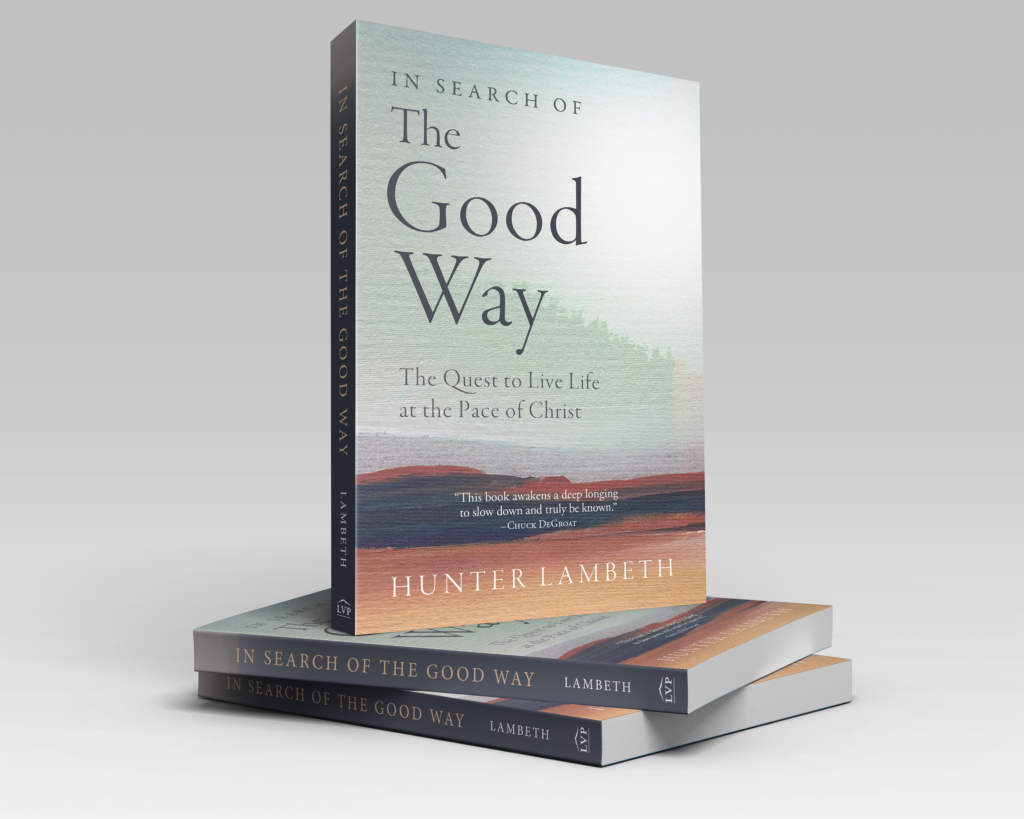
-An excerpt from Hunter Lambeth’s In Search of the Good Way
What if you were created to live life at a certain pace? At an optimal cadence? A “Godspeed” that allows you to flourish without burning out? Maybe you’ve been there before, but struggle to remain, especially when storms come, and you find yourself beaten and battered by the elements. What if discovering such a rhythm, one more in line with that of Jesus, meant stepping out of the rushed and hurried pace so indicative of today’s world? Would you be willing to take that first step?
Hunter Lambeth’s In Search of the Good Way is the story of a family, the Scarboroughs, who said yes, and launched themselves on a search for a life lived at the pace of Christ.
Selling their home, and most of their possessions, they left the comfort of the known for the mystery and the wonder of the unknown. In an RV they affectionately named Burley, they set out across America, not so much in the name of adventure, but rather on a quest to do the one thing the world around them seemed hell-bent against: slow down.
Woven together with the author’s own story of living in northern Israel-the very backdrop where Jesus Himself created a lifestyle template for all humanity-the book urges the reader to likewise consider a reorientation towards a life lived closer to the one for which God designed us.
In chronicling the Scarborough’s journey, Lambeth enlists the assistance of literary and spiritual voices, like those of Eugene Peterson, Henri Nouwen, Wendell Berry, N.T. Wright and Matt Canlis.
Reflecting on scriptures and real life experiences, including his half decade living in the Galilee, the author points us towards a place, a space, and a pace filled with hope and possibility. A life cadence in which we consider the words of Jeremiah 6:16, with its timeless instructions to stand, look, walk, and ask where the ancient paths are, in order that we might discover the good way-the pace at which we were designed to live-a pace that promises rest for our often-weary souls.
In Search of the Good Way is an uncovering, and a discovery, of these and other gems, that ultimately direct us to a greater intimacy with the Creator and the world in which He has placed us.
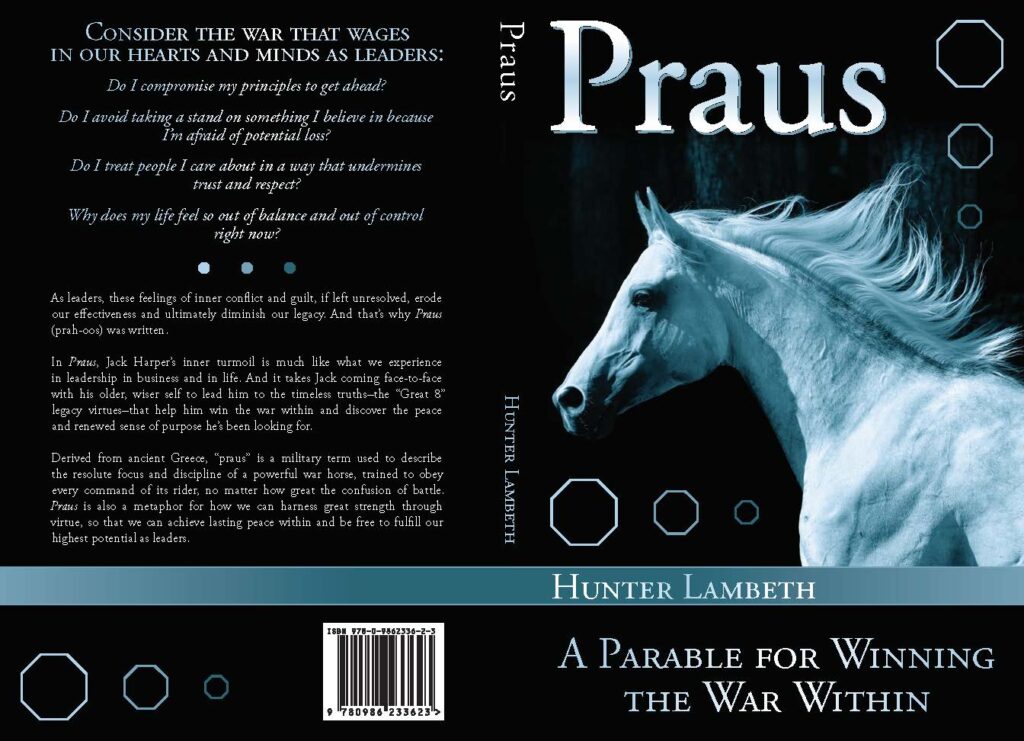
“Powerful book. Hunter Lambeth’s use of the metaphor of Praus — and the ancient warhorse — hits at the heart of what it takes to become a great leader in our time.”
“Hunter Lambeth has an intriguing way to draw in the reader – a great story and a great message.”
“A clever way to apply the beatitudes of Matthew 5 to modern day life, particularly in the business world. The interchange between Jack and the old man, who is actually Jack in his senior years, is a novel way of presenting a wise journey through life.”
Hunter Lambeth’s Praus is a powerful allegory that asks some profound questions:
Do I compromise my principles to get ahead? Do I avoid taking a stand on something I believe in because I’m afraid of potential loss? Why does my life feel so out of balance and out of control right now? As leaders, these feelings of inner conflict and guilt, if left unresolved, erode our effectiveness and ultimately diminish our legacy.
In Praus, Jack Palmer’s inner turmoil is much like what we experience in leadership, in business, and in life. And it takes Jack coming face-to-face with his older, wiser self to lead him to the timeless truths — the “Great 8” — that help him win the war within and discover the peace and renewed sense of purpose he’s been searching for. Derived from ancient Greece, “praus” is a military term used to describe the resolute focus and discipline of a powerful war horse, trained to obey every command of its rider, no matter how great the confusion of battle. The word is also a metaphor for how we can harness great strength through virtue, so that we can achieve lasting peace within and be free to fulfill our highest potential as leaders.
Praus brings all of these ideas together in an entertaining and fast-moving narrative, with a biblical parallel that evolves as the book moves to it’s compelling conclusion.